Monday, June 7, 2010

135,000 Fake YouTube Pages Delivering Malware

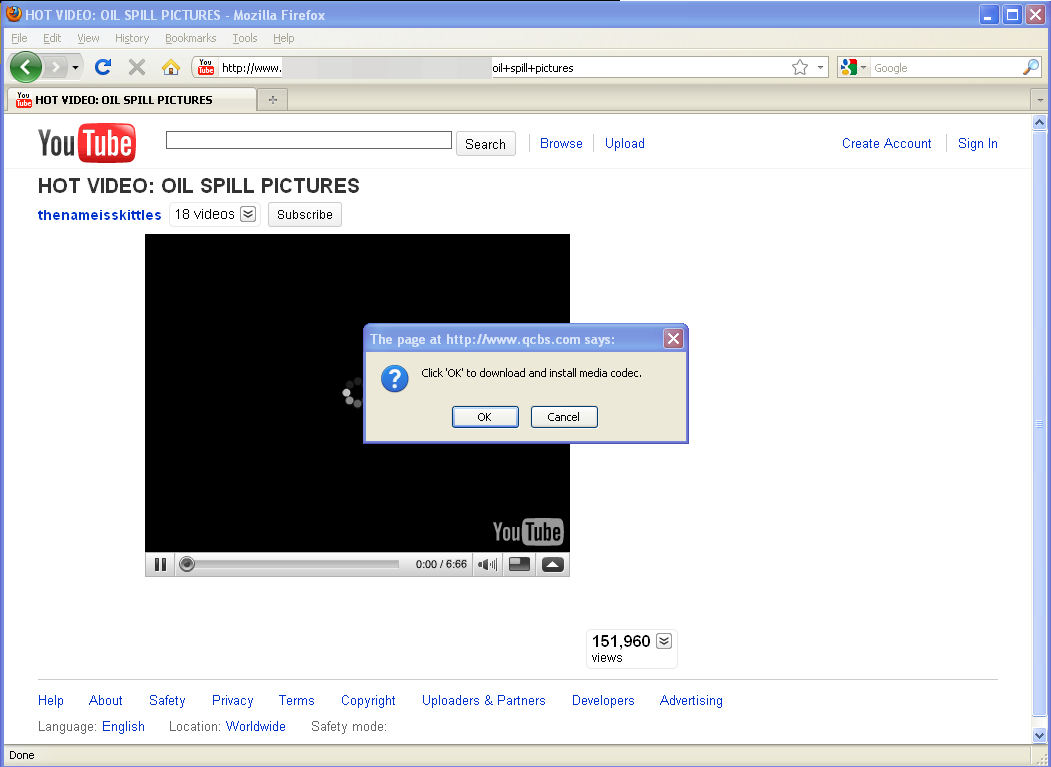
The eSoft Threat Prevention Team has uncovered thousands compromised web servers hosting fake YouTube pages.  Attempting to play the video on these fake pages prompts the user to install a ‘media codec’ which then infects the machine with malware.

The fake YouTube pages are well crafted and look almost identical to the real site.  By using websites like YouTube, cyber criminals are taking advantage of a users’ inherent trust in the site and are able to infect more machines.

Each page claims to have a “Hot Video” associated with anything from the Gulf Oil Spill to the NBA Playoffs.  Google search results show 135,000 of these infected pages at the time of writing. 

 
By clicking ‘OK’ to install the codec the user is redirected through intermediary sites to a final destination where the malware is downloaded.  After opening the file, the malware runs silently in the background giving unsuspecting users no sign that their computer is now infected and their data and computing resources are under the control of hackers.

Presently, this fake codec is actually a downloader Trojan with very low anti-virus detection.  Virus Total shows that only 8 of 41 anti-virus scanners currently detect the threat.  Without capable, secure web filtering to block access to these malicious sites these threats will have a high percentage chance of infecting users.

eSoft is flagging any sites hosting the fake YouTube pages as compromised until the pages are removed.  Intermediary sites and distribution points will also be blocked as compromised or malicious distribution points, protecting SiteFilter customers from infection.

Tuesday, May 25, 2010

Anatomy of a Modern Compromised Website

In the security community, little attention is paid to compromised websites that don't serve up malware. The malicious URL lists maintained by the anti-virus companies, by Google, and by nearly every other source of malicious URLs rely on anti-virus to trigger on exploits and malware to determine if a site is malicious. In a few select cases, behavioral analysis may be used to determine if a visit to a website will lead to an infected computer. But sites that are taken over by hackers are frequently used for other purposes besides directly serving up viruses or redirecting to sites that do.

When a hacker gains control of a site, they generally do one of several things:

  1. Nothing -- they sit on it waiting for a later date,
  2. Malware -- they load on exploits and malware or links to sites that host these in an attempt to infect visitors to the site,
  3. Defacement -- they put up a big notice saying they hacked the site,
  4. Attack relay -- they use the site as part of a chain of sites that lead to malware, or
  5. Hijacked advertising -- they put ads on the site or change ads on the site to make themselves the beneficiaries
  6. Blackhat SEO -- they use the site to trick search engines into thinking that some other site or sites are very popular and should be elevated in search page results


It is the last one, Blackhat Search Engine Optimization (SEO), where hackers are seeing so much success (see our previous blogs on this topic). SEO is the pseudo science of increasing a website's ranking in a set of search results. Landing at or near the top means more traffic to a website, which can mean advertising revenue or, if the site is malicious, a larger number of infected computers. In either case, the motive is money. And in some cases, hackers sell their SEO services and make money by increasing that search engine ranking.

In any case, search engine rankings are largely driven by popularity. The top results have links coming from many other sites where the more popular the sites that link, the higher the popularity of the site being linked. We call it Blackhat SEO because hackers use the websites they've compromised to host links to a website that they want to appear high up in search results. These links are usually hidden so that casually visitors to the site and the site's maintainers don't see them. The links are disguised by putting them off screen or using other techniques to make them invisible to a human visitor, while they remain perfectly visible to computers like Google's crawlers.

Take, for example, the case of Nauman Sod Farms, a small business in Iowa with a simple website that eSoft first flagged as compromised on February 4th, 2009. It was continuously rechecked and found by eSoft to be infected from then up through this posting.


It is easy to see why someone would think this site is innocent. To a normal user, it appears perfectly fine, but this small business is being exploited by hackers. If you view their home page without security precautions, everything looks normal. If you then disable javascript (using the NoScript plugin or your browser preferences) and reload the home page, you’ll see a long stream of cell phone related links show up at the bottom of the page including:


  • cf card gsm review siemens
  • unlocking nokia 5210e
  • tocatta and fugue in d minor ringtone verizon
  • motorola e1 secret codes
  • samsung le32r41bd
  • free download polyphonic ringtones through sms
  • motorola java games
  • law and order ringtone


In this case, javascript was used to hide the links, but that is not necessarily the case. And in this case, the links are search engine bait for various mobile phone searches, but we more often see links to pornography sites and malicious sites inside these PageRank Bombs.

In this case, two pieces of obfuscated javascript (meaning it is loosely encrypted to evade anti-virus signatures) add some code to the page that hides the links for those who have javascript enabled. This obfuscated javascript looks like this:

   document.write(unescape('%3C%73%63%72%69%70%74...

   dF('*8HXHWNUY*8J*5Fi...


and basically evaluates to this:

   document.write('<div style="height:1px;overflow:auto;\">');

where that height of 1 pixel is what instructs the browser to hide the links from a visiting user.

Scanning this compromised page with novirusthanks.org shows that of their 20 AV scanners, none detect a problem. Similarly, not one other URL checker shows any problem with this site including Google’s Safe Search and SiteAdvisor.

Unfortunately, in the case of this particular site, the infection runs deeper. Clicking through into the site offers up a new threat. At the bottom of the page, a hidden iframe has been injected. Essentially this means that the attackers have chosen to have the browser fetch content from another site but not for the purpose of displaying anything to the user. These are typically used to embed exploits hosted on another site onto the compromised site while reducing the maintenance effort. In this particular case, the iframe links to a page that is now missing, so for the moment, visitors are not being infected with malware. Based on our records though, the embedded iframe used to lead to malware, meaning that visitors to this site were targeted with viruses.


This site has been compromised like this for over a year without the owner of the web site knowing -- and this is quite common. It is difficult for security companies like eSoft to automatically notify website owners when their websites are compromised since public information about sites is frequently hidden through privacy screens or else leads to spam traps. eSoft's Threat Prevention Team reached out to Nauman Sod Farms four days ago using the email address on their site to alert them to the problem, but so far there has been no response and the website remains under the control of hackers. Until this is fixed and because of the likelihood of that the hackers may again start infecting visitors with malware, we recommend that folks avoid this site for now. Users of eSoft's secure web filtering will see this site marked as Compromised.

In general, we believe it is important to identify sites that are under the control of hackers even when those sites aren't being used to propagate computer viruses. These sites may at any time become threatening in that way and are frequently used as part of the machine that drives other sites where the actual malware is stored. The industry as a whole needs to pay more attention to these sites. In the meantime, eSoft does provide protection from these sites and identifies thousands like this one every day.

Friday, May 14, 2010

Phishing Scams Lure Twitter Users

The newest phishing scam on Twitter has snared thousands of users hoping to increase their number of followers.  Instead, users are sent off to a phishing page where cybercriminals steal their Twitter logins using them to generate more spam.

Thousands of spam messages are floating around on Twitter with links to increase the users’ follower count:

FREE MORE TWITTER FOLLOWERS!
CHECK out this site, im a member of it, gets you more followers
If you trying to get more followers check out
WANT MORE TWITTER FOLLOWERS?
Get more followers for free!


The cybercriminals use shortened URLs to prevent spam detection on Twitter.  Scammers are using a variety of URL shortening services to evade standard security precautions.

The shortened links lead to phishing pages capturing the users Twitter login, but never doing anything to increase the users following. The compromised accounts are then used to send more spam and lure in more unsuspecting users.


With more followers on Twitter, you’re able to expand your reach and connect with more people.  This makes for a very effective social engineering trick; taking advantage of user tendencies for malicious purposes. Users are typically none the wiser until spam messages start appearing from their account.

There are now a tremendous amount of 3rd party sites and services available to support the Twitter crowd.  It’s important that users remember not to give out login information without first verifying the legitimacy of Twitter applications and websites.  Most legitimate services now redirect users directly to the Twitter API and use the OAuth method of authentication.  Users should look closely at their URL bar to be sure they are on Twitter's site before entering their login credentials.


If you see strange spam messages like these showing up on your account, change your password immediately.  eSoft protects SiteFilter users from these phishing sites with the “Phishing & Fraud” category and is actively flagging new sites as they’re discovered.

Wednesday, May 12, 2010

Google Groups Latest Hot Spot for Rogue AV and Malware

eSoft researchers have been tracking a recent campaign abusing Google Groups to spread malicious links in Spam emails.  Users following the link are infected with a Downloader Trojan, silently infecting the machine with various types of malware including Rogue Anti-Virus.

The scam starts with an email asking the user to update their email settings according to the linked instructions.  The URL in the message brings the user to a Google Groups page linking to a malicious download.

Sample Email:


The link on the Google Groups page is a Downloader Trojan with better than normal virus detection.  58% of virus scanners detected the file as malicious on Virus Total.

The Downloader then does its job, downloading a mixed bag of malware from several locations. eSoft is currently blocking all known distribution points.  Among the malware downloaded is Desktop Security 2010, a Rogue Anti-Virus program.


A fake system scan is run notifying the user they’ve been infected and prompting the user to purchase a license key to remove the malware.


For only $89.95 you can get a lifetime license with special support. Users following through on the purchase have handed their credit card and other personal information to cybercriminals on a silver platter.

Access to the Internet through the browser is blocked until you’ve purchased a license, adding a hint of Ransomware to the mix.  Between this tactic and the official looking interface, unsavvy users are unfortunately easy prey.


Use of community sites like Google Groups, Windows Live, Blogger and others is becoming commonplace for cybercriminals looking to get the upper hand on web and spamfilters.  Secure Web Filtering with a combination of granular classifications and real-time URL lookups is the most effective way to combat these threats.

eSoft is actively identifying and flagging select Google Groups pages as Compromised as they’re discovered.  Other sites involved with this attack are blocked as Malware Distribution Points.


Update: May 12th 10:00 AM

It appears the spammers have switched tactics and are now sending fake ecards claiming to be from 123greetings.com. Users receive an email in the form below with an image link.  The links in the email use the same Google Groups URLs and present the same dangerous malware.  This new round of spam uses an even more effective social engineering trick than in the first campaign, and more unsuspecting users will certainly fall victim.


Thursday, April 22, 2010

Pharma-Fraud Continues to Dominate Spam

Have you taken a look inside your Spam folder recently?  Without a doubt you’ll find the folder full of pharmacy Spam, pitching everything from Cialis and Viagra to Vicodin and Hydrocodone.  The problem is almost none of the linked web sites are legitimate certified pharmacies.

Pharmacy Spam is delivered at an estimated 70% of global spam volumes, or 140 billion messages per day. These massive volumes are largely fueled by botnets such as Grum and Cutwail, creating all types of problems for business networks large and small.

These botnet operators are continually trying to find ways around Spam filters and web filters to earn money as part of the larger criminal operation behind these sites.  The latest attempt to get around these filters uses livejournal.com, a free blogging service, to link back to fraudulent pharmacy sites.  eSoft has seen similar attempts using other free blog services, including Windows Live Spaces.


In this example, a number of methods were used to get around Spam filtering technologies including using numbers and underscores (0rder_Now) to prevent the text from being detected as Spam.  A user following the link is taken to the Live Journal blog which then links them to the fraudulent online pharmacy.


In our research, the image link provided on each of the blogs linked back to many different “Canadian pharmacy” type pages.  eSoft has very good detection of pharma-fraud sites, finding hundreds of new sites per week.  Last year eSoft worked with the ThreatChaos blog to report on these sites.  The recent government crackdown has decreased the amount of sites coming online as compared to last year’s report, but certainly not stopped the operation or the related Spam.

It can be difficult to ascertain if an online pharmacy is legitimate or not.  The National Association of Boards of Pharmacy (NABP) provides some excellent safety information for buying medicine online.  Here are a few of the jaw dropping stats from their site.

• 83% do not require a valid prescription
• 42% offer foreign or non-FDA-approved drugs
• 55% do not provide a physical address
• 96% of sites reviewed are NOT recommended

At the time of writing, Live Journal has disabled the fake blogs we found using their service.  eSoft categorizes these fake blogs and the pharma-fraud sites they link to as "Pharmaceuticals" paired with “Phishing & Fraud” and “Spam” if the URL was detected in a Spam message.

Note that visiting these sites may result in stolen identity, delivery of fake products, further Spam and more.  eSoft strongly recommends sticking to lists of approved pharmacies and always using extreme caution and skepticism before following links in emails.

Thursday, April 8, 2010

Tiger Woods (Searches) Not to Be Trusted


Tiger Woods’ personal life and marital affairs have attracted constant attention from the press and has certainly damaged his public reputation.  With his return to the Masters only days away, Nike has released a new commercial in an effort to rebuild Woods’ image.  This compelling commercial is intended to spark a reaction, and may well be the next thing you talk about at the office water cooler.  Anyone who hasn’t seen it will go right back to their desk and search for the video. Blackhats have once again worked their way into these search results, leading users to malicious sites and Rogue Anti-Virus downloads. 

A user looking to see the commercial online would likely search “tiger woods commercial” – the search is heavily poisoned.  Out of the top 7 search results, six lead to Fake Anti-Virus pages begging the user to install malicious software.  The video results have also been poisoned to do the same.


With low anti-virus detection rates, users tricked by this attack have little to prevent them from installing downloaded malware.  In fact, only 1 out of the 20 scanners on Jotti detected the payload as malicious.


Users should also be wary of any Masters’ related searches as these will also be a target of cyber criminals. eSoft’s proactive detection of these attacks protects any SiteFilter customers.  Any sites associated with these attacks are being flagged as malicious or compromised.

[Additional Note: In this particular attack, the referring site is also important.  If the user is not coming from Google, or presumably other search engines they will be redirected to cnn.com rather than the malicious site.  eSoft has noted the use of this technique in the past, but it is interesting the attackers have chosen CNN for use in this campaign.]

Monday, April 5, 2010

Affiliate Programs Rising Cause of Fraud and Abuse

What happens when you offer up money to anyone who can drive traffic to your website?  Hackers, scammers, spammers and fraudsters come to your aid.  That’s the case with online movie site zml.com, which offers 30% of each sale and 5% of rebills paid via anonymous means to anyone who refers paying customers to the site.  And zml.com is just one of many.

In general, it works like this: a person signs up as an affiliate and is given a code.  If someone goes to the website with the proper code embedded in the URL, then a cookie is set and if that person later buys something on the site, the affiliate gets a piece of the transaction.  Outside of the shadows this means others are encouraged to setup ads or to refer friends to the site.  But on bigger scales, this can be big money, so the established cyber criminal community gets in on the action – not always by breaking the law, but certainly using shady means to drive customers to these websites.

Among the techniques being used by these shadow affiliates are blackhat SEO, fake blogs, spam campaigns and more.  These will frequently redirect through servers managed by the shadow affiliate and, in eSoft’s investigations, frequently used for other purposes such as malware distribution and phishing campaigns.

Windows Live Spaces is again being abused with a slew of fake blog pages covering hundreds of popular movies available for download. The download links redirect the user to a number of different movie sites that offer high paying affiliate programs.

Example 1


The blockbuster movie The Hangover is the sole blog post in the blog shown above and includes a promo image and full description of the movie with links to download. After a series of redirects to ensure the scammer gets paid, the user is brought to moviedownloads-pro.com. In order to download for free, the user must sign up for a yearly subscription with a credit card and our blog spammer gets a cut.


After signing up, the user is emailed a link to download software which we suspect to be questionable although we did not give up our credit card info to find out.  The affiliate network in this case is Marketbay, which is also home to some other very shady software including 14 different bogus anti-virus products.

Example 2


In another example, the eSoft Threat Prevention Team found the intermediary sites used by a shadow affiliate were hosted on the same site used in a ring of fraudulent "OEM Software" distribution sites we blogged about last year.  These links lead to zml.com, whose affiliate signup page contains the warning, "SEO or E-Mail spam is not tolerated!"  However, after sharing information of abuse with zml.com five days before the posting of this blog, we have yet to see the affiliate removed or to receive any response from zml.com.  In all likelihood, it is simply more profitable to turn a blind eye.


Using Windows Live Blogs to disguise URLs can be an effective way to get around some Spam and Web filters. eSoft reported on a similar tactic used to push pharma-fraud sites just a few months back. While this is nothing new, it goes to show that cybercriminals will continue these types of campaigns so long as they continue to be effective and profitable.

eSoft currently categorizes a number of these affiliates’ sites as Phishing & Fraud due to their use in Blackhat SEO campaigns and others are categorized as Online Ads or Spammed URLs depending on the methods being used to drive users to the links.

Monday, March 22, 2010

Obfuscated URLs no match for eSoft SiteFilter

Researchers at Kaspersky labs have discovered a new banking malware campaign that uses an old trick to obfuscate malicious URLs. Rather than using a domain name or IP address for their malicious link the URL is converted to numerical bases such as octal or hexadecimal formats. These formats are supported by major browsers and serve the purpose of tricking users into following the link and infecting their machine.

The post goes on to speculate that URL filters would have difficulty detecting and blocking the obfuscated URLs, leaving users vulnerable to these attacks. While many web filtering vendors may be susceptible to this attack, eSoft customers are protected. eSoft SiteFilter provides full support for these obfuscated URLs, filtering sites in ALL categories.

Using the example of playboy.com, the URL can be expressed in many different ways including the few examples below.

http://216.163.137.68
http://3634596164
http://0xd8.0xa3.0x89.0x44
http://0xd8.0xa3.0x89.68
http://0330.0243.0211.0104
http://000000330.0xa3.137.0104
http://0xD8A38944
http://033050704504

As shown on the Test a Site portal, eSoft correctly interprets these encoded addresses and detects each of these URLs as Pornography/Sex, the same as the domain playboy.com.


With the example found by Kaspersky, vendors that do not accurately filter these URLs leave users vulnerable to dangerous banking Trojans and end-user evasions. Malicious campaigns using this technique have been seen in the past and due to their effectiveness will be used in the future.

eSoft’s web filtering technology and focus on security provides users with unsurpassed protection against the latest web threats, including these obfuscation techniques.

Sunday, March 21, 2010

Cinderella Story Leads to March Madness Malware

The first week of March Madness has brought about many compelling stories, with a good deal of upsets and bracket busters. The most newsworthy of these has been the University of Northern Iowa’s ousting of #1 overall seed Kansas. This ‘Cinderella’ story has deservedly gotten a great deal of press coverage. However, those looking for information on the web may get infected with malware rather than a great story.

The eSoft Threat Prevention Team has been tracking search results on the story, and the NCAA Basketball Tournament in general, uncovering a great number of poisoned search terms. Searches for UNI Basketball or star player Ali Farokhmanesh return dangerous results leading to malware.


7 out of the top 10 results for UNI Basketball link to malware including the second result. The rogue anti-virus payload has very low detection among anti-virus vendors.

eSoft proactively detects and blocks blackhat SEO and search attacks similar to these using its automated systems and in-depth web site analysis. Any sites found are flagged as Compromised or Malicious, protecting eSoft SiteFilter customers.

Thursday, March 4, 2010

Virus Alert! Twitter, Google, Hallmark and Others Subject To Attack

The eSoft Threat Prevention Team is warning customers today of a new email scam circulating very quickly.  These fraudulent emails claim to be from Google Staffing, Hallmark, Twitter as well as other social networks and legitimate businesses.

The email persuades the user to open the attached zip file to find out more information. Users that follow through and open the file infect their own system and become part of the threat.

The very legitimate looking email below is just one example of the scam.  The email uses the actual Google logo downloaded directly from their website and easily hooks you into opening the attached file to find out more.


In this case, the downloader infected the system with a bot which immediately begins spewing thousands more of infected emails including fake e-cards from Hallmark, and invitations from social networks like Twitter and Hi5. 

The Twitter email is also very well crafted to make the user believe they were invited by a friend and is legitimately from Twitter.  The from address is spoofed to invitations@twitter.com with a subject “Your friend invited you to Twitter!”.  The body of the message begs the user to open the attached file - “To join or see who invited you check the attachment”.  Using this clever social engineering tactic the scammers are able to peak interest in finding out who may have sent them the message.  The user is tricked into opening the attachment and infecting their system.

As always, be very cautious opening any attachments and especially cautious when they are unexpected.  When in doubt verify with the sender or do not open them.